Showing posts with label modern art. Show all posts

Friday, April 25, 2008

Listen!

Harrigan is a docent at the Guggenheim, leading tours — "interactive discussions," which I now realize is redundant, "of current exhibitions" — and I thought it would be fun hearing her talk and a wide open door into art appreciation, so I followed her and about seven other people around the museum's current show, Cai Guo-Qiang: I Want to Believe. Not to be confused with the similarly-subtitled X-Files movie coming out this summer, like nine years too late.The centerpiece of Cai's show is Inopportune: Stage One, seen here lifted off someone's Flickr page. It's a pretty spectacular sight, and I don't have my own photograph because the Guggenheim has a team of security nazis telling tourists "no photography" and just being utter tools in general. I'll have more to say about this later.
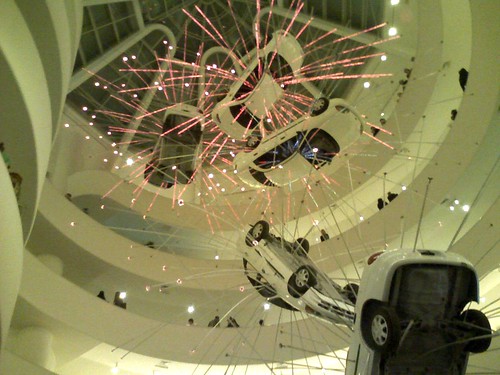
It took me a while to get a grip on what's going on here, even though Cai's liner notes (or whatever the art museum equivalent is called) make a point of his trying to make the show straightforward and free from the elitist art references that occlude so many other modernists' meanings. First I saw a bunch of cars hanging from the ceiling with colored light rods sticking out of them. Then the colored light rods sort of fused with my mental images of fireworks, which is closer thematically, yet still utterly wrong as an abstraction of the artist's experience and intent.

I've never been good at this art appreciation thing. I sat through my Art Humanities class in college convinced it was one giant trick question: everything was pulled from somebody's ass, on either extreme of obvious or obscure and never just fitting together neatly. We might be looking at a slide of Raphael's Madonna of the Goldfinch and the professor will point out that the figures of Mary, Jesus, and John the Baptist form a triangle, and a triangle has three sides, and there are three manifestations of God in the Holy Trinity so (duh!) this painting of Mary, two creepy naked babies, and a bird represents the Holy Trinity, and the class will be gaping like she just solved the Da Vinci Code. Connecting any three points with straight lines will make a triangle — sort of the definition of a triangle, there — and there are lots things that come in groups of three. Maybe Raphael was foreseeing the Stooges. It's possible.

Spoiler alert: Inopportune is Cai's artistic depiction of a car-bombing, conceived in the media frenzy after 9/11. We got the background from the non-interactive part, the respite, of the discussion: Post-9/11, pretty much up till the present day, the morning news would start your day off with whatever footage of a car skeleton, a rubble-strewn street, and some number of people dead came over the wire last night. In his frustration, Cai and his uncredited team built Inopportune, a kind of multiple-exposure image of a white Chevy exploding up into the Frank Lloyd Wright rotunda. I was actually pretty fond of Fireworks in Dangling Cars, at least on an aesthetic level, but it's one of those things where you take a second look and see the work of someone who's bitching about media overexposure through a five-story installation in the entrance of a major museum. Discuss.

The methodology behind these "interactive dialogues," Museum Tours 2.0, comes straight from the darkened college lecture hall. Harrigan gave us a little background, then asked, "What do you see?" There's always somebody in the group who's really eager to speak up, plus somebody in the group ready to give an abstract answer to a very temporal question. "Liveliness. Chaos." (It's not Mondrian, but you'd need a really OCD life to pull uncontrollable chaos out of Cai's exhibition.) "Why do you think Cai insisted on using American cars?" Harrigan asked us, loaded but inevitable, and, "[There's an unmodified white car on the lobby floor, by the admissions line, and another one on the top floor, at the very peak of Wright's famous circular ramp.] Do we think the cars are falling, or are they going up?" And Final Jeopardy: "Why do you think Cai chose to call this show I Want To Believe?" In teacher mode, and she's good at this, Harrigan reminded us that there are no wrong answers — no mention of stupid answers, however — so feel free to speak up...

...except there are wrong answers, and I respect Cai for that. The cars, another spoiler coming up, are deliberately falling upwards, for example. This revelation turned him from an attention glutton in my mind to a pretty clever guy, at least with regard to Inopportune. You can't pick up the visual evidence in the picture I copied, but Cai's car-bombing in time transitions from (an abstraction of) reality to a sort of consoling quantum-mechanical fantasy: the explosions' colors become cooler and less realistic, blues and pinks, as the installation reaches upwards, and he imagines the car landing on the top floor, whole, and upright. Cai's thoughts on the piece pretty clearly draw an image of hope against the depressing media blitz, but that's really facile for somebody in his position, like I said, hanging from the ceiling of the Guggenheim over thousands of gawking visitors.

What somehow became clearer in the post-9/11 media coverage, and I think what's so obnoxious about the images of terrorism broadcast that they reinforce the fundamentalists' attitudes towards your fear and your role in the larger world. The crawl, the talking heads, the dead count in Iraq (but, rarely in the Sudan, Myanmar, or — until it could be linked with Westerners protesting a sports event — Tibet): the world is so complicated, run by corporations and institutions, that you, the average nine-to-five worker or dispossessed immigrant, have zero agency. You might join with 71% of your fellow population calling for an end to the war in Iraq, and the guy running the show just says, "So?" With Inopportune, Cai crosses from media outsider to insider (the fact that he was always an art insider notwithstanding) and becomes the same shrill, dogmatic voice that pushed him into the project in the first place.

Inopportune rejects dialogue, and I feel like it does so much more insidiously, non-profit, than the media does. Yes, you can talk about the work, how it makes you feel, how you respond to it, in a group of six camera-wearers and a grad student volunteering her time. So long as you're insulated, you remain a consumer instead of a producer. So long as what you say doesn't actually matter. That's why you're not allowed to take pictures — it's not like the artist doesn't want his work preserved as a framed two-dimensional digital representation, because there are plenty of professional photographs of I Want To Believe flying around the web. Cai... well, I'll give him the benefit of the doubt... his patrons maintain their power, their importance, by being the sole presenters of the work, just like the mass media. Why have curators if some yokel visiting from Podunktown can decide whether Cai's work is important, and by whatever philistine pseudo-Democratic American Idol Kinkade-skewed criteria they use, no less!

So I'm being subversive here, saying what I really think of the piece, just like getting your daily news off of Digg.com. But I realize that without Cai's notes, and the Guggenheim's curation, I would've just been looking at some cars with lights. It's not that I mind being told what somebody else thinks; it's the disingenuous nature that starts controlling how I think that bothers me.

Saturday, December 8, 2007

A Completely Impartial Review of the New Museum

I got to check out the New Museum — and let's not start a slapstick routine here, that's the museum's name, okay? — yesterday, about a week after its re-opening and re-imagining. I never had very nice things to say about the old New Museum... er, the previous New Museum, except that admission was only three bucks. The art was nothing memorable, save for one animatronic sculpture on temporary display of a boy fucking a goat, and a piece by Tom Friedman that was a six-inch sphere of cursed space, which is totally cheating. Some of Friedman's other work was less dickish, which is why I can't remember any of it.

I guess they tore the old museum down, quietly: I spend a good deal of time in Soho and blissfully unaware of the move. The new New Museum is, according to the pompous jackass art critic in the Village Voice (and having a last name that's both hyphenated and has an acuté accent ain't helping, Christian), "an instant classic." This dude so wants to sleep with the New Museum. The museum is, from the outside, a stack of precariously-balanced gleaming white boxes, kind of cool and inviting on its own... but the hyper-modern structure lives on the Bowery, a street most notable for its many grunge punk rock clubs and restaurant supply stores, and to say it doesn't fit in is an understatement. Not that I'm particularly fond of the Lower East Side ex-tenement architectural vibe, but the new glass and fiberglass buildings popping up like zits feel like Tim Gunn walking into the Bowery's homeless shelter in his thousand-dollar suit and shiny tie and making fun of what the residents are wearing.

Speaking of which, all the staff at the new New Museum has to wear these black uniforms with, like, leather shoulder patches, and they totally made me think of rebel storm troopers on casual Friday.

The show, "Unmonumental," is the same tired, lazy, pointless sculpture and installations we've come to expect from modern artists, and I guarantee that everybody on display is friends of a friend of a curator. Admission is twelve dollars, which goes to support performance artists walking up and down the street, screaming love poetry "a reflection on the difference between speaking and listening—a kind of confession combining the idiom of politics, the transmission of secrets, and the language of love." Do what I do and bring along a friend who works at one of the city's art museums, is totally into art, and is therefore obligated to go to the New Museum and think deeply about "the Object in the 21st century" anyway. They get an art community free pass plus a guest pass, so it's like I get to be an incomprehensible douche for a day, too!

Like I really need an art museum to do that. ;)

Briefly, the exhibition includes — and I'm not sure that I didn't hallucinate this whole thing — a bike, on top of a pile of fuschia bricks, with bags of rocks hanging off the handlebars, a pole sticking out of its back, a fur drape hanging off the pole and a picture of Mel Gibson taped to the fur.

Normally, there's this moment where I challenge the artists to justify themselves, taking up my time and energy and potential for a MacArthur Genius Grant, but not anymore. The justification is damn futile; the artwork, like the museum itself, is self-absorbed and solipsistic, unaware of anything beyond its own boundaries — like the idea that just maybe, there's some poor guy walking to work on the Bowery, he just wants to sell his restaurant supplies and now this indifferent behemoth is suddenly blinding his eyes and not purchasing a pizza oven. Nothing in the New Museum is the Ecstasy of Saint Theresa, for example, celebrating the resplendence of God and beauty and salvation. The pieces here have no context, no story, and they rarely even serve as examples of whatever abstract, abstruse philosophical psychobabble the artist's trying to reflect.

I did, however, like the bathrooms. They had this high-speed hand dryer thing, and it was like all whoooooosh!

Friday, November 16, 2007

Meeting

I met up with some friends, and some friends of friends, this evening and brought them to P.S. 1, which... if you ever want to impress your crew with both how much obscure, over-the-river New York City you know and how coolly Zen you are, P.S. 1 is the singular place to bring them. It's a branch of my still-loathed Museum of Modern Art and full of dippy, over-commentaried installations, but redeemed by James Turrell's awesome sanctuary Meeting, guaranteed to leave jaws agape.

It's both easy and hard to describe: a white room, wooden bench around the perimeter, and a hole in the ceiling. A skylight, literally. Turrell pulls off some sort of optical illusion where the ceiling's maybe twelve feet over your head, your eyes scan across to the hole and the sky is right there. At my first Meeting, there was a debate among my friends, "Is that just twilight projected onto a screen? It has to be. I bet they're pumping cold air and wind in the room... no, look, there's a plane. How did he do that if it's a screen?"

Once your mind resolves the issue, the Turrell room is a great, chilly little place for meditation. No one will stop you if you need to sit in lotus position for hours or perform corpse pose on the bench, and there really aren't too many places where a bunch of grown adults, strangers to each other, will lie on a dirty carpet together and it won't be awkward. Plus we got lucky with a perfect, deep pink evening where the illusion crept closer and closer as dusk turned to night.


Credit for the photos goes to Harrigan, who's a photo ace. Seriously, she was setting the aperture and exposure manually. I can barely take pictures that aren't motion-blurry...

Same scene. My picture:


Harrigan's picture:

Not that my picture doesn't have its charm, but I was going for something a teensy bit different.

Also on display, this guy. Min Tanaka, a conceptual artist putting on a special live exhibition. So watch the video, and see if you can guess what his conceptual art gimmick is. (Note: I had the camera sideways, filming, figuring it would correct itself. Oops. Doesn't matter, since he's not any less inexplicable rotated ninety degrees.)


If you guessed that he "dances the space around him," because you are unaware that "dance" is an intransitive verb, then you are correct. Also, he doesn't like being videoed, since some security ninny told me to put the camera away, even though there were at least five professional photographers in the room, blocking everyone's view, and taking snapshots. So I didn't get on camera the part of his dance where he randomly bangs his head against the wall, presumably because the space told him to do so.

Thursday, September 6, 2007

Richard Serra at the MoMA

I saw it. I got in for free. It was bullshit.

But the real shocker was just how bullshit the Richard Serra retrospective (I don't know: is he dead?) was. The pride of the exhibition was its collection of loopy, sinuous, kind of twisted iron walls with names like Torqued Ellipse and and I really have nothing to say about them conceptually. I was a little annoyed about the MoMA's constant admonitions to not touch the artwork, because they are, after all, just rusty iron walls. Unless Superman comes into the museum and starts leaning against stuff, it's not like there's going to be any major shifts in Serra's vision. But overall, I can see their aesthetic value, if not their artistic value and each one's kind of cool.

You walk into but don't touch the first wall circle thing, out in the courtyard, and look around, and you're like, "This is interesting. It's not really a circle and it's at a bit of angle, so it's kind of disorienting." And then you walk into the second one and you're like, "This is interesting. It's not really a circle and it's at a bit of angle, so it's kind of disorienting." There's four or five more inside, and you're like, "This is a little less interesting. It's not really a circle and it's at a bit of angle, so it's kind of derivative of the first two." By the time you walked through the entire exhibit, you feel a little ripped off. I mean, I know they're not all exactly alike, but they're all exactly alike.

Hey MoMA, that's cheating!

It's like if I write my novel and donate it to the library, and then I write my second novel using the first one and Microsoft Word's find and replace feature, and donate that to the library too. Only one counts. And maybe it's cool in Serra's case because maybe the different curvy sculptures were installed in different locations, but if the MoMA's charging twenty bucks to get in, I expect a little variety.

Also, this thing here: not art.

Wednesday, August 29, 2007

Who The Fuck Is Jackson Pollock?

I've always found the modern art world just a little inaccessible, and people — well, artists — give me shit about it. Nothing personal. But I never really believed it was nothing personal, and Harry Moses's documentary Who The Fuck Is Jackson Pollock? vindicates me. The movie is your typical slobs versus snobs story, questioning the "value" of art through the eyes of unlikely critic Teri Horton, a 73-year-old truck driver and stereotypical crotchety old lady. Horton was in a thrift store when she came across a tabletop-sized canvas, "paint all over it, no picture." Teri's reaction was, "It was ugly," but she bought it as a gag gift for a friend, negotiating the price down from eight dollars to five. Funny story: Teri's five dollar painting bears a striking resemblence to the works of Jackson Pollock, whose paintings sell for twenty to twenty-five million dollars at auction.

Teri entered the privileged universe of art dealership with a simple question, is this piece legit? The answer — not that I'm surprised — is fascinating, as the painting itself becomes less and less relevant and its authenticity, or lack of authenticity, is a product of the huge social class gap between the people who regularly sell million dollar art and the people who serendipitously find it in a thrift store. The experts Teri asked, the kind of people who'd spend thirty-thousand dollars on some guy's poop, didn't say no; they laughed her out of their galleries.

The final word on the authenticity of an artwork belongs to the International Foundation of Art Research, who issues its judgments in anonymous reports. Ever notice how people who make subjective decisions affecting others always issue those decisions anonymously? Who The Fuck Is Jackson Pollock? reminds me of Kirby Dick's investigation into the MPAA ratings board in This Film Is Not Rated. The legitimacy of their power is fragile, so they issue anonymous decrees that nobody can challenge. IFAR's position is given voice by Thomas Hoving, the former curator of the Metropolitan Museum of Art and a former editor at Connoisseur magazine, and a condescending douchebag so insufferable I have no idea how he manages to walk down the street without getting punched repeatedly in the face every ten minutes. Hoving's the kind of asshole who would edit Connoisseur magazine; he introduces himself by pointing out that the opinion of a security guard at the Met is worthless, but as the curator for eighteen years, his expertise is invaluable.

I can't believe that Hoving's imperious personality is typical of art connoisseurs — he's the guy who lets Sean Hannity rail about the liberal elite, but a sizable part of the art market belongs to old-money conservatives and evil corporations. However, his attitude seems echoed all over the place. He quickly dismisses the painting; it's "neat dash compacted, which is not good." It's pretty, superficial, and frivolous — ironic words coming out of Hoving's mouth. The clincher is his evalutation of Teri: how dare she be upset that we art experts don't believe her painting is for real? Who does she think she is? I have a degree from Princeton; she isn't even a Sarah Lawrence dropout. I live in an Upper East Side apartment; she lives in a trailer park. It's people like her — dilettantes — who are ruining this great nation!

In his defense, not that he deserves a defense, the art world has changed in the past twenty-five years or so. Art for art's sake (or status's sake) has become a big business, and the art market runs on the "provenance," tracing the piece back, owner by owner, to the artist. Hoving's expertise aside, the paper trail is objective proof of a work's authenticity (assuming it's not forged). As an art appreciator, Hoving is becoming obsolete. The thrift store where Teri found her painting had some poor record-keeping, but forensic evidence strongly suggests that the painting is Pollock's. There are fingerprints in the paint proving that the same person touched Teri's painting, a paint can in Pollock's studio, and an undisputed Pollock.

So there's three viewpoints, the philistine (Teri: "There was nothing to it. It was just all these different colors all over the canvas. To me, a painting has to have something you can look at and say, 'Oh, that looks cool, like Norman Rockwell or someone like that.'"), the investor, and the erudite art-ophile, all asking the fundamental question, "Where's the value in art?" So you see Martin Creed's The Lights Go On And Off and wonder if it's good art... Sotheby's pulls out a balance sheet and checks if it's increased in value, Hoving strokes his ego by saying if you don't get it then it's your problem, and Horton's opinion is irrelevant. Art is no longer expressive; it's just a medium for intellectual masturbation among the rich and shallow.

Art is whatever comes from the hands, or out the ass, of the art community. And the art community is an exclusive club of people (or robots or elephants or whatever) that create art. It's like the Writer's Guild or Skull and Bones. Something suggests that if an elephant's brushstrokes can be (valuable) art, then my brushstrokes should definitely be considered art. I can just imagine Hoving spitting at that idea. It really is personal when those art dealers kick Teri out of their store.

And of course there's something anti-American, certainly anti-egalitarian, about the self-defined artists' community, justifying recycling itself in its abstract, meaningless gibberish. I'm offended by the hypocrisy, or the denial, or just the disrespectful pig-headedness of modern art, conflating aesthetic value with provenance. Horton got an offer to buy her still unauthenticated painting for nine million dollars, about forty percent of its worth should it be declared legit, and turned it down. Good for her, standing on principle, even if the principle is "the value triples once it falls into important enough hands."

Sunday, February 18, 2007

Art Makes Me Cranky!

We did a Chelsea gallery tour yesterday; it's one of those few weekend things you can do in New York that's both snooty and free, plus Anne had to see certain artists' shows for her discussion forum in class. With Anne there, the whole experience of looking at art was new for me, since she's in a graduate level art criticism class and can come up with a sophisticated critique of what's on the wall, and I'm capable of relating everything to my insecurities and jealousy issues. I sort of observe Anne's thought process — and we ran into a bunch of her classmates during the gallery tour, and I got to watch their thought process too — and I really have to empathize with their innocuous art ideals: Let's try to figure out what this piece means, notwithstanding the fact that much modern art is pure gibberish to begin with. Maybe today's art students are tomorrow's asshole artists and art critics, but I'm actually pretty impressed with their ability to extract something, anything, from the pieces they're studying. I usually go with my gut instinct, which is, someone's playing you.

The first show we saw, The Shape of Time by Qiu Zhijie, was actually quite beautiful and emotionally resonant, and that was enough for me. Twenty-four photographs representing the twenty-four seasons of the Chinese calendar, each one taken with with a very long shutter speed, long enough that the artist could use a flashlight to "write" the name of each season on the photograph. My personal favorite is "Start of Autumn," a playground at night bathed in a weird, artificial green light, and the effect is hypnotizing. The Shape of Time is at Chambers Fine Art, 210 Eleventh Avenue, through the 24th, and even though getting over to that corner of Manhattan takes more time than you'll actually spend in the gallery, I recommend it.

Everything else was crap, but at least it was different styles and smells of crap. Our next stop was some dickweed gallery that exemplifies every single thing that's wrong with modern art, starting with their whore's exhibition, and I don't mean that in some metaphorical sense. Back in 2003, Andrea Fraser prostituted herself for "Untitled," an hour-long video of her boinking a collector for the bargain price of $20,000. I haven't seen the piece, but I'm totally fit to judge it. (Not sarcastic there: Look, if it turns out the piece is more than just the concept of "attractive so-called artist sleeps with rich collector for a chunk of his money: is it art?" then I'll be wrong, but my guess is that the idea just makes it a glorified porn video.) "Untitled" lives at the crossroads of our celebutard culture and the self-enclosed, self-gratifying art world, a combination of the post-modern delusion that meta questions about what qualifies as art make up art, Fraser's belief that her status in the art community automatically grants a greater meaning to anything she'll do — like we seriously believe that she'd be fucking someone poor or a rival's patron, and the idea that her piece stands on its own. Maybe she's too exhausted after that hour of sex to come up with a title? God, what a bitch. I hope she at least got chlamydia from her art.

Fraser's current show is in two parts: nude photographs of her apparently grafted atop classical paintings of nudes, which took me like half an hour to interpret and by then, I just didn't give a damn. And the video. Let me say, right now, that I am totally against mixed media artists or performance artists or whatever making movies, and I don't just say that because I sat through Miranda July's painfully pretentious Me and You and Everyone We Know. Not that artists can't make films for the sake of filmmaking, but you have to realize that since films, unlike the thing hanging on the wall, occupy a period of time, you need to keep your audience engaged. Frasier's ten-minute film shows her walking through the Vatican Museums, listening to the audioguide and pretending like she's not being filmed, and it's just ridiculous.

I know what she was thinking, too. She wanted to comment on how we (note the art critic's best friend: the vague, all-encompassing pronoun) experience art: The throngs of tourists crowding the Vatican aren't seeing the religious art with the awe and reverence the Renaissance masters intended and, worse yet, they listen to the audioguides to enhance the appreciation of the art that they don't have in the first place. Which is all well and good: it's just that the video doesn't say that. The press release Fraser sent out to Abstruse Intellectual Art Monthly says that — hell, my blog says that — but my blog isn't on display in a gallery, and rich women aren't offering me $20,000 to fuck them and then write about it.

Third stop was Ian Davis's uninteresting show, which apparently "incorporates the systems and geometry of minimalism within a descriptive style of painting that is timeless in its simplicity." That's the first sentence of the press release. You'll note that "descriptive style of painting" doesn't mean anything, and you can't really call something "timeless in its simplicity" unless it's been around for a long, long time. But anyway....

"Favoring the depiction of entropic situations over specific narrations, in Davis's universe systems crash and things fall apart. Whether populated or not (very often by groups of identically dressed men), all of his works retain a strong masculine presence, tinged by sardonic humor."
The best I can say is that his work is, in fact, very often populated by groups of identically dressed men. I often wonder which comes first: the painting or the press release, because this is pretty much the same A-minus nonsense I wrote in my Art Humanity papers, and my essays just parodied these press releases. Like, I totally missed the masculine presence (maybe Davis sprayed his musk on the paintings?), the entropic situations, crashing systems, and sardonic humor.

So by now, I'm kind of hungry and kind of grumpy (well, grumpier), but we had to move on and we say Doug Aitken's show 99¢ Dreams at 303 Gallery. I looked pretty kindly on the show, at first. The highlights, in my mind, were "Wilderness", a panel of hexagonal mirrors turning slowly at different angles; and "disappear", a panoramic photograph of a plane graveyard, cropped into the shape of the word DISAPPEAR and then put in relief from the wall, so it looked like it was protruding either into or out of the wall, depending on how you looked at it. There was also a funky-shaped marimba with nine notes that the public was invited to play, but I casually disregarded that as insipid. The trouble started when Anne and I decided to play "Figure Out The Theme of the Show, And Don't Refer to the Press Release for Help." I guessed that Aitken was trying to express the idea that what we see is a function of our physical relation to the object we're looking at, and then I realized that's a totally vapid statement, and then I realized that didn't necessarily mean I was wrong.

But alas I was wrong. Not even close. It turns out that the pieces are an expansion of "[Aitken's] fractured merger of mediums and information systems," which actually seems parseable, so I tried to parse it. "Information systems" are, I assume, systems containing information and "mediums" are the manner in which that information is transmitted to the receiver (that would be you, the person looking at the art). Aitken has merged the information with the transmission method, and then broken his (info + transmission) thing — although what I suspect he means to say is that the content of the information you receive can't be completely separate from the manner in which you receive the information and thus you can never receive the information the way it was intended. When I translate it into Comprehensible for you, he's really not saying anything that you didn't pick up playing that telephone game in kindergarten.

Okay, continuing with the second sentence of the press release: "These works combine light, sculpture, moving images and sound." That is true. I probably could've figured that out without Aitken explaining it, since I have eyes and ears and a sense of perspective in three-dimensions, but whatever. I'll pretend like you didn't just condescend to me, Doug. "For example, 'don't think twice ii', [random comma, sic] is made up of two over lapping [sic] concentric circles that proceed through an animated sequence..." I'll give you this one, too, Doug. God, you're embarrassing me! 'don't think twice ii' is made up of two overlapping concentric circles that proceed through an animated sequence. And here I thought you were full of shit! "By stripping away traditional representational imagery, these works get to the essence of a moment."

I'm so relieved! What the hell does that mean, "essence of a moment"? And how does one "get to the essence of a moment"? And how does "stripping away traditional representation imagery" get one to the essence of a moment? And finally, what does this have to do with the fractured merger of mediums and information, or did Doug forget all about that by the time he pulled the fourth sentence of his press release out of his ass?