Sunday, March 30, 2008

Making Out with Chemistry.com

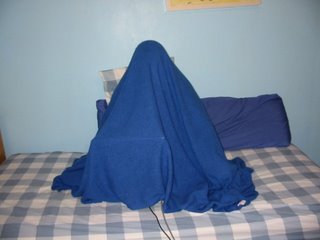
Hey, my chemistry.com profile got its first hit! It happened just before I upgraded to Profile 2.0, so I'm giving credit to Harrigan's portrait for this one. I can't really explain it, cause it's just an image but fits me, or I fit it, or something. I think my blanket fort photo that I use for this blog's profile captures my personality more fully: working, isolated, shrouded, but enjoying the child-like pretend of it all.

But people look at the content of the picture, rather than the decision to express yourself with one photo over another, so the blanket fort one comes out on the third(?) date. My computer-generated match doesn't have a photo on her profile; there's a little box that says something like "Photo will be available after the first date." Which, by then, it won't be quite as useful, will it?

Photo not available. That can't be a good sign, can it? It's not like your photo isn't in the yearbook because you were out that day; this subtext was a choice. I'm trying not to read into it, especially since on my proactive side, I'm not being the profound person we should all aspire to. I'm certain we'd — I would, and most of you would, too — make better decisions blind. Chemistry.com sent a profile of this one really cute girl who I have absolutely nothing in common with (I guess the computer disagrees), and I'm having this primitive hormonal struggle to not press the "I'm Interested" button next to her pic. I'm sure I've rejected a few good matches, too, because they weren't what I'm looking for, literally.

Here's a link to an interesting article on first impressions, how accurate they are, and how quickly we make up our minds about someone.

The expectations, too, aren't working for me. You don't strike up a rapport with anybody, and there's no "take it slow" option. All of my previous girlfriends were my friends first... and of course, by "all," I mean "both," including the one who I never technically met, and I guess we were just friends for a week or so before making our tacit AOL commitment to each other ("You've Got Puppy Love!") but still, my point. There's less chance of rejection — always a fear — and it seems more organic. You two already like each other more than you like anybody else, so why not date?

This game of jumping right in because a computer told you to doesn't leave me feeling quite right. Don't guys become actors on their first date, feigning normalcy, interest, all kinds of crap they think the woman wants? And since the facade matches what she's been socialized to expect, she thinks that's his real personality. Sounds like an exhausting way to have a relationship. I'm not necessarily big on honesty — I'm for recognizing when mendacity is appropriate — seems like a first date would be the perfect time to be yourself. All you've got to lose is someone who wouldn't tolerate you well anyway. (Also self-esteem.)

Wednesday, March 26, 2008

Profile. (Love me!)

My chemistry.com profile was... not the way I want to portray myself. The chemistry.com website folks throw this personal essay at you and won't let you finish the questionnaire until you finish it, and I did my extemporaneous best, but that wasn't very good. Full of making a first impression awkwardness, which fades off after some getting to know you. Here's what I came up with:

I introduce myself as a bit of a mystery. I'm shy and it takes a little effort to lure me out of my shell, but I become outgoing, carefree and really sweet once I'm lured out of my shell. Right now, I'm an aspiring writer, but I design websites and write Java code to pay the bills, because crumpled-up second and third drafts aren't legal currency. My humor is dry and sarcastic and occasionally pushes boundaries a little too hard. I love animals, not so much kids, play the piano, and bake the world's best cinnamon-kahlua brownies, not that I like to brag or anything. I get off on learning new things and exercising my mind, so I've grown into a profound well of useless (and sometimes useful) knowledge. I'm open-minded, or at least I try my best to be, but also pretty picky -- life is short, so why spend it on things that aren't good, right? But at the same time, you never know where you'll find stuff you like.

Likes: tropical fish, fast elevators on the way up, those fringe sports they show on ESPN2, Nintendo Wii, empty amusement parks, the smart car, Wile E. Coyote, Venice in the early morning...

Dislikes: ferns, socks, Wal-Mart, fast elevators on the way down, passive-aggressiveness, the word I missed in the fourth-grade spelling bee ("villain"), ten-lane highways, movies that have the main character's name in their title...

Here's the part where I describe who I'm looking for. I could list a bunch of standard traits: honesty, sense of humor, independence, etc., but that's what everybody says because they have no idea what to put down here. My sense is that you can have an meaningful, intimate relationship with just about anyone, and your soulmate is somebody who shares your emotional maturity, who's different enough that they make you a better person and similar enough that you make them a better person. That's vague. Sorry. I did say I was a bit of a mystery.

It's not the world's shiniest sales pitch, but I feel like it gives you a good sense of who I am. I had a hell of a time writing it, even after some brainstorming sessions, because it's not like you're introducing yourself to anybody and it's a super one-way conversation. What I did was go to Match.com and pretend to be the person I'm looking for — twenty-six year old woman seeking twenty-four to twenty-eight year old man — and get a sense of what other dudes are selling.

This, accidentally, became a really fascinating glimpse into other people's psyches. Oh yeah, the other thing I did cause I wasn't really thinking about it, was I typed in Fanwood as my location and among what the Romance-O-Matic™ spit back were profiles of a few people I've known since I was wee high. Not great friends or anything, folks I'd say to if I saw them in the post office or if I needed to know what last night's homework was or whatever. But I only know them through the persona they show in public, and it's interesting to see the contrast between the straightforward facade that I know (or interpret) and the mess of contradictions that they believe about themselves. No way in hell he's "kind of shy." He's the biggest sycophant ever and he "values independence in a woman." Bullshit!

You know you're supposed to put your best foot forward, but you're also protected behind the anonymity of a username and IP address, so the profile winds up being a mix of how you actually see yourself and how you want to be seen, and the balancing act between the two. My hypothesis is that the pretense in somebody's public facade is inversely proportional to their profile's ratio of punctuation to misspellings.

My favorite, least expected motifs in guys' profiles (not sure if it holds for the girls') is the subtle apologetic tone that sneaks in. "I'm not sure what to write. I've never done online dating before, I'm no good at talking about myself." Lowering expectations, and boy does that sound nice. I probably slipped in some temptation to do that in my own profile, trying to come off as good enough to date but so good that she'll be disappointed when I my nervous, stuttery first date doesn't live up to the hype preceding it. Many of the profiles, almost all of the profiles are so generic and bland that they're almost meaningless. "Sweet, sensitive" guy who "also has a wild side" enjoys "a night out on the town" but also sometimes "wants to chill at home" — editorial note: no matter what's on a list of thing's he'll do, play sports, travel, go to museums, fly on a trapeze, whatever... "chill out at home" is always last on the list. — Looking for a "cute girl" who "has integrity and independence" and "values honesty" with a "good sense of humor" and "up for anything."

How is that useful? It's like contrasting to a dating profile that says, "Yup, I'm a loner who quit his job and spends all his free time stocking my basement with bottled water and canned food. I'm on the hunt for a disrespectful, stern lady with low self-esteem to repopulate the world after the dirty bomb." I'm a little curious how that profile would fare; this is a world where death row inmates receive marriage proposals and fringe weirdos make a living selling fallout shelters to other gun-toting backwoods crazies. I guess what I'm saying is that maybe there's someone for everyone.

I really don't want to know. I'm little afraid the millennialist profile would get more responses than mine.

Friday, March 21, 2008

Getting Away From It All

I don't know if I told you, but I'm planning a vacation. Somewhere. Anywhere. It doesn't matter. Siberia or Patagonia or a secluded spot in the Pacific for all I care. Not that there aren't better places, but as long as there's prepared food, a bed, and it's not here, I think I'll be happy. (Aside: I left out the part about food and a bed in my first draft, then thought better about tempting God to crash my plane, Cast Away style, in the middle of the ocean, spending my last two weeks alive in a life raft, fighting sunstroke and subsisting on turtle blood.) Looking back through my notes, I've been planning a trip since November — and then looking at my calendar, it turns out that was five months ago, so I have an annoying nagging thought that by the time I'm actually ready to travel, I'll be booking tickets on a Star Trek teleportation device. Which will be slightly less onerous than flying.

I used to have this globe in my room, and I'd point and spin it and fly wherever my finger landed, but then the political landscape changed (stupid Cold War ending!) and it was no longer possible to travel to beautiful Yugoslavia. So the globe got trashed. Here's my new travel criteria, aside from the destination being "anywhere:" It's got to be someplace easy, for a green circle traveler, because I'm not going to be bribing border guards or spending twelve hours on a bathroom-less train or anything. Someplace cheap, too, which eliminates most of... everywhere, thanks to rising oil prices and a pathetic dollar. I eventually settled on Buenos Aires, Argentina, the Paris of Latin America. Tourists flock to Buenos Aires to see the widest street in the world and... other stuff, I guess.

When I went to Italy — my calendar claims it was a year and a half ago — I went solo, as evidenced by these dopey pictures of me pointing the camera at myself. I know most people travel with their friends or family, but, much as that sounds like fun, it doesn't really work for me. My family hasn't left the New York metropolitan area in six or seven years now, and I have enough trouble planning a trip with my friends to the movies, let alone another continent. Traveling alone has its benefits, "daytime" benefits — namely I can go where I want, when I want, and tolerate however much foot ache and exhaustion I want (which turns out to be a lot). But the advantages solo traveling has in the daytime are balanced out by the nighttime limitations, when the tourist stuff, the crap you just have to look at, shuts down and the social scene comes alive.

This time, I thought I'd sacrifice the itinerary planning that I really do enjoy and look for a tour group, especially going someplace where I've never been before, don't have relatives, and haven't spoken a word of the language since Sesame Street. I found some companies running these demographically targeted tours, ages eighteen to thirty-five, and I'm going with the one that has the most attractive people in its brochure. Also, the one that had the common sense to refer me to a travel agent... who's now got me convinced that the Euro's not that strong and it's possible to do Europe on a hundred bucks a day while still having all that food and bed and not being stranded in the middle of the ocean discerning travelers like myself expect.

Now I'm looking for the most gloat-worthy trip I can find. England and France are automatically out because everybody's been there (except me). What I'm thinking is maybe Berlin to Budapest with stops in Prague, Bratislava, and Vienna: "Suck it, peers! Bet you can't say you spent a day in the Republic of Slovakia!" How Robert Ludlum of me. Or another promising possibility is the Russian Adventure, starting in Riga, Latvia and passing through Russia, Helsinki, and finally Stockholm, although I don't see the point in going to Sweden if you're not spending a night in the Ice Hotel.

The ultimate trip for rubbing it in your friends' noses, though, has got to be Virgin Galactic, where that fucking tool Richard Branson will take you into space. I should really scrape together the $20,000 deposit and book now, because it won't be nearly as cool once commercial space travel goes mainstream.

Wednesday, March 19, 2008

News: Greedy Corporation Gets Too Greedy, Taken Over by Another Greedy Corporation

The reports I'm hearing make it sound like the collapse of Bear Stearns (NYSE: BSC) is a national tragedy: Treasury Secretary Henry Paulson had to work over the weekend, people! JPMorgan (NYSE: JPM) continued its hundred year old tradition of robber baron-dom and bought out Bear Stearns, which was worth ten billion dollars at the start of the year, for about two-hundred thirty million dollars, which happens to be less than the value of Bear Stearn's office tower. And JPMorgan, which is a multi-billion dollar corporation in its own right, made this acquisition through a government grant — your taxpayer dollars at work. That's the real bullshit: "Secretary Henry, why JPMorgan? You could've given me $230 million dollars and I would've spent it on Bear Stearns." I might have taken a couple hundred out of that gift for a new iPod or something.

I have zero sympathy for Bear Stearns' 14,000 now-redundant employees, who were all riding high during the real estate boom, buying junk mortgages (sort of) with money that didn't exist (sort of). Poor traders, losing their six-figure bonuses, and their country club memberships. There's a twinge of regret for Bear's non-trading staff, but I consider them to be enablers who share responsibility for the mortgage crisis.

Monday, March 17, 2008

Bacchanalia

I've noticed that just how major a holiday is in the American cultural lexicon is directly proportional to how shameless your stereotypical fat, loud, obnoxious Americans' celebration is. Christmas is, of course, the big one, and you can tell because it's the only holiday we celebrate by illuminating our houses until they're visible from space. Easter is on the other end of the spectrum; I wonder how it worked out that it's okay to celebrate the birth of Jesus Christ wearing a red and green snowman sweater that plays "Jingle Bells" and drinking a rum-cream cocktail, but the gaudiest thing you're allowed to have for His resurrection is shredded cellophane. And I also want to know how St. Patrick's Day made it into the pantheon of Holidays It's Okay To Wear A Stupid Sequined Hat on.

It's cool if you're Irish and celebrating because it's your patron saint's feast day, but America, in its way, has dumbed down Ireland's great contributions to civilization to shamrock stickers and singing "Danny Boy" off-key. This might not come off so clearly when I write, but I actually like other cultures, especially in contrast to my own non-descript ethnology, the "melting pot" or "salad bowl" or mishmash of ideas only connected as they fall under the description of "diversity." That being said, I don't understand the Irish-American mythology (or, contrasting, my own Italian-American mythology). First-generation Irish immigrants, I imagine, would carry their culture with them, but we're celebrating today because of the diaspora, the tragedy that Frank McCourt generalizes from even though he's a century or two removed. Once your cultural identity has been co-opted to sell colored marshmallows to kids, you've pretty much assimilated, thanks.

But once your culture's become fodder for facetious race war horror (sample culturally sensitive line: "I'll take it from you, homie, you'll see, cause you know the Leprechaun is the real O.G."), the meaning of the holiday disintegrates. It's Halloween without the witches, or Memorial Day without the flag, or Father's Day. (I exclude Christmas here because, although it's become utterly secular, I don't see people spontaneously giving each other gifts on any other day of the year.) St. Patrick's Day is an excuse for frat boys to drink at ten in the morning, as if frat boys need an excuse to drink at ten in the morning. Culture, that heterogeneous life experience shared among different peoples, may be dying already, but I feel like its this dishonesty that's killing it.

Friday, March 14, 2008

Big News: Politician Has Sex!

I don't know if you heard, but it appears New York governor Eliot Spitzer is "linked" — that's the word the media's clung to — to a prostitution ring. Lord help us! The man violated the sacred bond between him and his wife, and that just proves that he's incapable of running the state government, because those two concepts are totally related. You know who'd make a great executive leader? The guy I have in mind has never been involved in a sex scandal, although he has a few other kerfuffles in his career: there was this minor forgery thing, these incidents in prisons he set up, and he sort of oversaw these decrepit veterans' hospitals, and there was this time he put this horse judge in charge of FEMA, and he accidentally compromised national security by leaking the identity of a CIA agent, and once or twice or three times he bribed the press, and he kind of subverted our democracy and our system of checks and balances, but not a single sex scandal. Except this one. And this one.

See, the difference between the Bush scandals and Spitzer's high-end hookers is that when Bush fires eight U.S. Attorneys because they refuse to advance his political agenda, that matters. Not only does it directly affect the Democrats who are unjustly persecuted — I mean, prosecuted — but also the body politic, as the representatives inject their own partisanship into our government. Spitzer, on the other hand, might have hurt his family — not that the New York Post was complaining when that Moment of Truth lady threw away her marriage on FOX — but it's completely separate from the state government and its role in the citizen's lives. Spitzer's indiscretions don't threaten anyone else's marriage, do they?

As usual, our sex-phobic culture overreacted to what's irrelevant and continues to ignore real, albeit less lurid, issues. Maybe people will pay more attention to the economic crisis if we surround it with strippers.

Along the same lines of public actions that matter and private behavior that doesn't, I don't see why we're not legalizing prostitution in the first case. Somebody wants to purchase sex, someone else wants to get paid for it — why should anyone else be getting involved, telling them to stop? Calling him a hypocrite is fair enough, but it's not like Spitzer is the first politician ever to say one thing and do the opposite.

Thursday, March 13, 2008

Marquee

I get e-mails from this Netparty organization that brings young professionals (and me) to an after-work club for drinking, coat checking and business card exchanging, often in that order. I don't go for the networking so much as the high-end nightclub, and also to share my hilarious, ironic business cards. Last night, Netparty held their event at Marquee, the "quintessential ultralounge," whatever that means. I don't buy it, because Marquee has its name on the front door and I think the quintessential ultralounge would try its hardest to stay a secret from me, like I'd need a gay makeover and a guide from TMZ.com to find the damn place.

My sense is that, no matter how exclusive the club is, if you're there early enough and dressed like you have money, they'll let you in. Netparty started at six; I arrived at 4:15. You get there early, you find the place, see the layout, no surprises. You get to practice your skulking skills, too — I set up surveillance across the street, curious about how early the line would materialize. (Well, not quite: First I walked around the neighborhood, all warehouses cum galleries, looking for a Starbucks. Then I lowered my expectations and looked for anyplace to sit down. Then I raised my expectations and looked for someplace to sit where I wouldn't get rained on. Then, failing all three, I decided to ponder the question of how early is early enough.) Aside from the people working the event, the first arrivals came at 5:47 — interesting, since at the last Netparty dance club blowout, the line was stretching around the corner by thirteen minutes to opening.

So, speaking of confirmation bias, I was the only person there by myself. Everyone else was either with their friends, calling their friends, or texting their friends. To fit in, I called that special number on your cell phone that tells you how many minutes you've used up, then thirty seconds later got a text back so it looked like I was legitimately waiting for someone. Man, that's retarded.

One thing I picked up on, though, was that no one was networking. There were a few people in sales going around the room, making small talk, collecting my hilarious, ironic business cards, but for the most part, everyone kind of stuck with the little group they came in with, kind of defeating the whole point of this exercise.

Tuesday, March 11, 2008

Jumping to Conclusions

I updated my blog's title after reading through some of the old crap I wrote and realizing, or coming to terms with, that my thoughts are less fascinating than they are... uh, impetuous. Honest, too, and organic, but since I bitch on other people's impulsive, rash gut reactions, it's fair that I at least recognize spewing my own rote responses drawn from a functional narrative rather than reality, then justified post hoc: Well, they are morons. At least I'm not wrong there.

In my defense, I usually write these commentaries in public, naturally surrounded by jackasses. Like these two people at the table next to me, having their twelve-inch conversation but with their playground voices: God, I'm right freaking like three feet away from them! Are they even aware that I can hear every single stupid word of their stupid conversation? Are you familiar at all with how sound works? And I don't give a damn about Wendy or the audition she just landed or how she's getting back together with Jim because it has absolutely nothing to do with me so why are you invading my personal space with your twaddle! I'm not up in your face, even though I could, but I'm not because unlike some people I could mention I'm not a solipsistic inconsiderate piece of...

Sorry. Sort of a habit.

Seems like there's a correlation between this need to spew my impulsive thoughts and those thoughts turning out... not exactly wrong, but simplified and devoid of the nuance that makes living as an imperfect being among other imperfect beings interesting. Like these two chatterboxes next to me, who would probably be decent people if they'd just take the conversation somewhere else. Or who I'd probably even like if they were talking with me.

I suffer from a confirmation bias — the other day I ran into the subway station just as the train was pulling out and, "Shit, I always just miss the damn train!" — I'm sure I knew on some subconscious level. No matter how strongly I've concluded the universe is out to screw me, I cannot reconcile that the trains are trailing me, scheduling their arrivals and departures as to not coincide perfectly with mine — speaking of solipsism!

This means I'm working on questioning all of my assumptions, though that's easier to do when I don't have other people's inane blather a few feet away from me. Microsoft Excel and I are going to track my experience, whether it's positive, negative, or overall neutral. I expect that it'll turn out to be more or less neutral, maybe a bit on the self-fulfilling prophecy negative side, but I believe I'll validate my own sense of victimhood of divine impishness. I also believe I'll have cause to question my methodology.

Results to follow.

Sunday, March 2, 2008

Time Management

I have zero time management skills. Can anybody help me out with some advice on how to cram maybe twenty-six or twenty-eight hours into my day? I don't mean the common stuff, like action plans or setting goals and priorities and putting them to paper. And I'm certainly not talking about cutting back on four hours of TV and four separate hours of porn I look at every day (sometimes they're not separate). Along with my hour and a half commute each way, I don't get a whole lot of sleep.

But I say that, no cutting into fun time, without being ingenuous or sardonic. For instance, I caught that Amy Winehouse video on VH1 — the one where she's a dazed whore, writhing on the floor to an awesome beat — and those four hours of TV a day clicked with me for a second. In between partying, getting soused, snorting coke, and recovering from partying, getting soused, and snorting coke, where does she find the time to film a video? Not to mention writing, recording, performing, and drinking more.

Point is, it's possible. I've read that Stephen Covey self-help crap: put first things first, but his advice was either too inane or not inane enough to be helpful. (The big problem I run into is the First Thing gets tripped up in Murphy's Law, and once the whole mess is worked out, there's not enough time for the Second and Third Things.) So, ideas?

Friday, February 29, 2008

Brits: War Too Dangerous for Prince Harry, Okay for Everybody Else

The British press threw a temper tantrum when Matt Drudge reported that Prince Harry, who matters to them for some reason, is serving with their army in Afghanistan. How could Drudge be so callous towards the prince's safety, the tabloids bitched. Foppishly. And also, the Brits had the story two months ago but signed a deal with the Ministry of Defense promising not to publish anything till Harry was back in his London palace bed. British media to Drudge: no fair!

I've never been more proud to be an American, coming from a land of freedom, where semi-professional ad hoc journalists can spread the news without kowtowing to the big divine right lobby. Twenty-four hour news cycle, people, and you'll report on "Dog's tricks are 'better than TV'" and "Fat-carvers bring home top prizes," but not "Third in line for throne serving in Afghanistan?" This is what people want to read on their way into work; think of the advertisers and the stockholders. Think, if you compromise Harry's safety enough and get really lucky, you could see two spikes in readership.

Not that I'm really surprised, but everybody's skirting the real issue here. The media that signed this deal with the army, now that they've been screwed, chastise Drudge's callousness toward the safety of Harry and his unit — marking the first time the British tabloids have ever been concerned for the well-being of one of their subjects. And of course that subject just happens to be in the middle of a fucking war zone, but let's delude ourselves that war isn't supposed to be dangerous. Then the reporters left out of the inner circle are above it all, in an ethical debate over whether one guy's safety overrides the public's "right to know."

But that's a false dichotomy, or it would be if not for the real ethical knot here: the media's cozy relationship to its source and the principles they're willing to sacrifice to maintain that relationship. None of this off-the-record, shady deals nonsense; a reporter's job is to report the news under the theory that the readers are smart enough to filter it. The press shouldn't have spent the ink to write about Harry's detail, not because the Ministry of Defense asked them nicely not to but because it's not newsworthy. Some "news" just isn't relevant to anybody's ability to participate in the civil structure, and the press also has a responsibility to make sure that what's trivial stays trivial.

Look, I don't need to know exactly where in Iraq our troops are stationed and where they're going to patrol today and what time they're having breakfast — and I don't really care either. All I need to know is whether we're kicking insurgent ass, by which I mean providing enough stability for the Iraqi government to restore the nation's infrastructure and secure the borders. And I need to have enough faith in the media so that when the reporter in Basra tells me that we're kicking ass, I can be confident that we are, in fact, kicking ass. Then I use that information to decide whether I want the old guy, the black guy, or the woman to be my next president, and that's how democracy works.

Wednesday, February 20, 2008

The Dating Game

One of the items on my list of New Years' Resolutions that will never be fulfilled is dopey and coy, Meet Someone Special, like I'm in a forties screwball comedy and I'll bring the whole wrath of the Hays Code down on my ass if I use the word "girlfriend." I haven't been on a date since college, and I haven't been on a first date since high school, when the courtship ritual took place in an AOL chat room with "a/s/l every1?" and then "anybody wanna have sex press 19." Which, is that still appropriate?

I remember back when I was ten, if you like-liked a girl, you could communicate your profound connection by punching her in the arm or dumping mud in her hair, then skittering back to your posse, with the other neo-apes throwing rocks at each other. It's truly amazing that we even survived each other long enough to reproduce. That was so nice and simple: if she didn't like you, she'd tell on you; and if she did like you, she'd tell on you but still come back the next day for more. We grew and developed language, and subtext, and then she dates an utter tool but also complains that she's dating an utter tool, and this is all very confusing to me. My road map to true love, or empty no-strings attached sex, is a tortuous M.C. Escher mobius strip; I'm lost and haven't really moved, in fear of falling off into the abyss.

I began sketching a new outline of this uncharted territory for me in super-light pencil (actually dry-erase marker) with the best, albeit pedestrian, ideas I could imagine:

  • Get Harrigan to take a decent picture of me. I don't think I look bad at all in real life, but somehow the camera always manages to capture me in that 1/500th of a second that my countenance is a distorted facsimile of a psychotic Mr. Potato Head. I put my second-favorite picture of me up in my little dating profile (my favorite picture is the one of me in my blanket fort in the "About Me" section of the blog), but I look like I'm trying too hard to force a smile, even though I was genuinely happy when I took the pic. I blame the megapixels or something. If it's all possible for me to look good in freeze frame, Harrigan can do it. She has mad photography skillz, a couple of giant professional digital cameras, and, maybe even a lens that gives me six-pack abs and a chiseled jawline.
  • Write up a chemistry.com profile. My current profile is a list of my flaws, insecurities, allergies and skin conditions ("leprosy-free for over eighteen months!"). I've done a little brainstorming for a blurb that's not intentionally self-sabotaging, but nothing coherent yet.
  • Go where there's people. Duh. Despite my best efforts, there are still approximately zero dating possibilities in my bedroom.
  • Ask my friends...


...which I did. Over lunch with Sylvia, I asked her if she knew of anybody and I was completely unprepared for her answer: "Well, what are you looking for?" I never thought about it before. I guess you could read it two ways, but I don't think Sylvia was telling me that I wasn't going to find anyone by reducing the applicant pool down to its most common features, a pair of x-chromosomes. On the contrary, I just assumed I'd wind up settling ━ the cause of so many mid-life Porsche purchases ━ for whoever fate threw my way. There's the small possibility of getting lucky, like with Anne, being star-crossed as in the first half of Romeo and Juliet... but I was always more a fan of when they retardedly killed themselves. Ha, ha, that's what you get for falling in love! Stick with the passionless arranged inbreeding your families destined for you. But the very idea of actively looking for somebody, for something that I want (and facing rejection) was downright mind-blowing.

Tuesday, February 19, 2008

A Perspective on The Wire

You've probably been too busy following Lost or American Gladiators to pay much attention to The Wire, which is the best, and most disillusioning, show to ever cross the airwaves and not come into your house. I'm surprised I went seven weeks without talking about it, and I've been particularly shaken by the final season so far, walking away from three shows agape, "Holy shit..." This season's Institution of Massive, Unabashed Failure is the media, and the storylines explore what's been hinted at previously: the twisted, co-dependent relationship between the hegemony of news organizations and, the root cause of all the world's ills, you (yes, you) and your simple-minded complacency. Set a year after "A New Day in Baltimore" never materialized, the broke-ass city is still perpetually desperate for political capital but also actual, monetary capital. Carcetti sold his soul to the powerful upper-middle class white wing of the Democratic party, brushing off the governor's offer from last season and leaving the schools in the same unacknowledged decrepit, useless condition from last season. The cash crunch has reached into the Baltimore P.D.; the five percent raise Carcetti enthusiastically promised the police department is being paid out ━ or, more precisely, not paid ━ in sheets of office paper, to be redeemed on that glorious day when the city actually has a few coins in its coffers. The media, the once-venerable Baltimore Sun, not a real newspaper but "still a pretty good newspaper," is beset by similar financial privation and, suffering takeovers from the Los Angeles Times and then the Chicago Tribune, abandonment from a corporate structure with other things on its mind. The institutional mantra in Baltimore is "more with less," which is even more retarded than it sounds.

The one institution thriving in Baltimore's new day is the New Day Co-Op, and particularly Marlo, who's consolidating his power after a year-long hiatus while under scrutiny from the MCU. The MCU, which was shit-canned twice when the city did have money, is disbanded along with its investigation into the row house murders, and McNulty is shipped back to his perch, and continuing downward spiral, in homicide. This season, more explicitly than any of the others, asks how the common people, shlubs like McNulty, just trying to do their damn jobs for Christ's sake, get ━ that is, wheedle or extort ━ basic resources from The Powers That Be, y'all and your wallets, and what that makes them and their society. It would involve using you, an ATM for your own good, and examining the moral consequences later; I'm reminded of House: "I teach you to lie and cheat and steal...and as soon as my back is turned, you wait in line?" So The Wire presents three parallel scenarios: McNulty, after a lot of alcohol, tampers with crime scenes and old cases to manufacture a serial killer terrorizing Baltimore; Clay Davis finally faces exposure of the shady non-profits he's been skimming from; and a Sun reporter, Templeton, makes himself the paper's new golden boy by fabricating quotes and making up the news. How do we get what we want, what we're entitled to, or what we believe we're entitled to? We give you what that base, emotional, jumping to conclusions part of you wants ━ whatever that is, it's pretty cheap ━ and you reciprocate.

That's where the press comes in. The utopian idea is that the media is supposed to provide us with the information we the people need to run our country, it being a democracy and all, but with that in mind, I'm starting to realize how phenomenally irrelevant it is. I'm talking about the opening to the six o'clock news: a minute on someone shot in Rockaway Beach, another minute on somebody stabbed in Bayonne, then three people shot in Morrisania, all in critical condition, with some blonde reporter standing by at the hospital's ambulance bay. This, followed by, "Danger in the kitchen: which household product that you own can kill your whole family? We'll tell you, at eleven." What am I supposed to do with this "news?" More to the point, shouldn't we assume that all this, and the context it creates ━ You are not safe if you leave your home! Also, you are not safe in your home! Buy plastic sheeting and duct tape! ━ is bullshit anyway and the weather forecast is the most honest, straightforward part of the news?

So McNulty creates a "Homeless Strangler" character (that would be a guy who strangles the homeless, not a homeless guy who strangles ━ important difference), broadcasts it around, and gets nothing. I've always wondered this about the media, especially the sensationalist tabloids: in the exploitative, parasitic relationship between the papers and their readers, which comes first, the public's interest or the media's interest? The Chicago Tribune, being a business operating in a free market, would argue that they give their readership what it wants; as a (potential) reader, I note that my options are limited to what the media chooses to provide me. The serial killer story McNulty gives the press ranks somewhere in the middle of the Metro section. It seems formulaic: Alma's triple homicide story wound up in the same insignificant nether-zone. Number of victims, divided by how far on the fringes of society they were, plus salacious details equals location, with some bonus points for being white, an ex-cheerleader or pageant queen, missing in Aruba. Templeton, always the attention glutton, has to pretty much beg McNulty for some gripping detail for the story, something front-pageworthy, something the Post and Daily News could make a tasteless pun on.

Certain critics, who I respect even though I wish I had their jobs, read this, McNulty's serial killer yarn, as the moral decline that really costs him his soul. His transgression: making shit up? Deceiving people? He hits rock bottom ━ which is inane hyperbole in The Wire; rock bottom is more like Bubbs accidentally poisoning Sherrod ━ after giving Larry, a crazy homeless guy, a hundred bucks to relocate to Richmond and pretend to be the Strangler's next victim. Which is wrong, but morality on The Wire isn't merely a mess of gray areas but a complete condemnation of the right-and-otherwise dichotomy Sepinwall forces on it. (Oddly enough, Sepinwall lets this quagmire slide when it comes to Dexter: he does bad things for a good reason, but he's working through it.) There are bad consequences and there are bad consequences; so in this week's episode, Kima has to tell the parents of McNulty's crazy homeless man that their son, who they could no longer care for and had to let go on the street, was probably a victim of the Strangler. And it is awkward, quoth Sepinwall:

Last week, I talked about how Jimmy's abduction of Larry was the moment where he took his scheme way too far, but Kima's interview with the parents of an earlier "victim" show that Jimmy's actions have been reprehensible from the start. Sure, the dead guys are in no condition to care about what's being done to their corpses, but Jimmy's lie is devastating the family members. Like the parents say, it's bad enough to live with the knowledge that you didn't (or couldn't) prevent your son from killing himself with drugs and alcohol, but it's far, far worse to believe that you failed to protect him from being murdered and sexually molested.

Interesting, in a season that twice called out Sepinwall's medium (he's the TV critic for New Jersey's own Star-Ledger newspaper) for showing more sympathy for white victims than black victims, and for upper-class victims than poor victims, he complains about how McNulty's lies affect a white, middle-class family with nary a word about the twenty-nine (by my count) black people that Marlo had murdered, including our friends Bodie, Prop Joe, and Butchie. The Wire gives us this amazing omniscient panaroma, where the full butterfly effect of everyone's actions become clear, and still our own parochial viewpoint takes precedence. Let's review: The MCU's budget and personnel are slashed, Marlo immediately resumes consolidating his power. Marlo consolidates his power, he represses the West Side community, pays more to shady lawyer Maury Levy, makes more "donations" to Prop Joe's fake churches and New Orleans hospitals (which are likely connected to Clay Davis, especially given the land deal Nareese brokered for that drug dealer slash strip club owner), and in particular buys more heroin from the Greek. The Greek sells more, he ships more Slavic prostitutes to America in cargo containers, not to mention whatever he does with his implied terrorist connections. Reading in the paper that your son was murdered and molested (assuming the Sun printed that, even though there's no confirmation that Crazy Larry was either) must be horrible, maybe even almost as bad as being dragged to a vacant by Chris and Snoop, or working as a sex slave in freaking America.

It's not that Sepinwall's ethical take is wrong, especially given that, as I said above, McNulty isn't extorting resources because he wants to catch Marlo but because he thinks, as a homicide police, he's entitled to some resources. But The Wire is full of characters who make ethical decisions that are, let's say, short-sighted, and the degenerate world thrives on them. This season I may admire Bunk and Kima for doing the right thing, real policework (although it seems like Bunk wouldn't have re-opened the Marlo investigation if McNulty's selfish jackassery hadn't put him in a bind), but at least McNulty isn't taking the ethical shortcut the System lays out for him and passing responsibility to somebody else.

This attitude is persistent in Baltimore, under the guise of "fairness" and "political correctness." We saw the same thing last season in the schools, with our sympathies reversed because it was children at the bottom of the shithill instead of drug pushers. I'm thinking of the scenes where Donnelly socially promotes a finally thriving and clearly unready Dukie to high school, effectively ending his education. "Did I do something wrong?" he asks. No, it's just too much trouble, from the superintendent, the media, City Hall, having him in the school and she is long past that. "Have some kids of your own," she tells Prez, who's protesting Dukie's promotion, as if helping nobody is morally superior to helping just one person. All of these institutions that are supposed to make us civilized instead leave a Hobbesian world where there's no loyalty, and no altruism, to anybody but you and yours. Then the police complain that these gangsters won't snitch.

Sunday, February 17, 2008

Trick Question

I found William Poundstone's excessively-titled book How Would You Move Mount Fuji?: Microsoft's Cult of the Puzzle ━ How the World's Smartest Companies Select the Most Creative Thinkersin a long-forgotten corner of Barnes & Noble last Friday, just as my brain was starving for more fodder. Poundstone is an unclassifiable author, although if I had to, I'd say he examines intellectual gnosticism in the tradition of Martin Gardner or Douglas Hofstadter. He's written about topics such as the Prisoner's Dilemma, clandestine "numbers station" radio broadcasts, the secret ingredient in Dr. Pepper, and the Minnesota Multiphasic Personality Inventory. I guess the common theme is that they all require some critical thinking against the status quo to make real sense of. How Would You Move Mount Fuji? is an expose of sorts on the Microsoft job interview process, how Gates and Ballmer find the best and brightest computer scientists to revolutionize your desktop with Clippy, Minesweeper, and a bunch of other bloated programs that individuals, apparently not the best and brightest, in the open-source community have made much-improved versions of. I don't understand why anybody would even want to work at Microsoft: I mean, have you used any of their programs?

Microsoft receives about 12,000 resumes a month. I have some personal experience resume-vetting from my intern days, and I can tell you that it's easy to sort applicants' life experience, condensed to a single sheet of paper, into piles of "never" and "maybe" spending no more than ten seconds on a resume. (Interestingly enough, Poundstone cites a Harvard study that suggests the hiring manager has already made their decision about you within the first two seconds of the interview, before you've even said a word.) Ten seconds per resume means three-hundred sixty resumes an hour, two-thousand five-hundred twenty resumes per seven-hour workday, and over twelve-thousand resumes set aside or rejected every week. Microsoft, like many large businesses, has replaced the resume monkey with keyword-scanning software, which sounds more efficient except for the fact that it's Microsoft's keyword-scanning software and therefore probably dies a Blue Screen of Death every twenty or thirty resumes. Microsoft Resume 2007 Professional Media Edition rejects three-quarters of the applicants, and the remaining one in four gets an all-expense paid trip ━ I assume flying coach ━ out to Redmond, Washington for full-day interviews of the, um, open-ended variety. How would you move Mount Fuji? If you could remove one state from the United States, which would it be? How many piano tuners are there in the world? Presumably, there's a question or two about computers in there, too.

I have a love-hate relationship with brain teasers. I bring this up because, while reading Poundstone's book, I've come up with a new and subversive answer for the question, "How many windows are there in New York City?"

Q: How many windows are there in New York City?

You'll recall that the old answer ━ which, I should point out, doesn't technically answer the question asked ━ requires taking a representative sample of New York City buildings, counting the windows in the sample, then dividing by the percentage of the city that the sample represents. Not that this is a particularly obfuscated answer; it's a straightforward answer to a straightforward question asked in a dickish manner just to make the applicant sweat.

A: 2,109,356.

Q: Really?

The trick is that you have to give this answer with supreme confidence.

A: Exactly.

See, I have this issue with my fellow language-users, and that is that I'm never all that certain whether to take people's ambiguous words at face language or not. Like, I'm ninety-five percent sure that what the interviewer means to ask is something along the lines of, "How would you approach the problem of determining the (exact?) number of windows in New York City?" He wants access to my critical thinking, but he's not asking a question that requires critical thinking. He might as well ask me what the capital of Azerbaijan is (Baku) or what's America's longest suspension bridge (the Verrazano Narrows): either I know the fact or I don't.

Q: How do you know?

The intended question.

A: As to the number of windows in New York City, I know that you don't know how many windows there are. Even if I did pull this number out of thin air, you can't prove that it's wrong. You'd have to count either all the windows in the city, or 2,109,357, whichever is smaller, and you're not going to do that.

Maybe I did just happen to stumble across that statistic the other day, straight from the City Bureau of Windows, Doorways, and Portholes.

This is probably not the ideal way to ace a job interview, pointing out the interviewer's ignorance and subverting the whole process by taking advantage of that ignorance. New question: if you could remove any state from the United States, which would it be? (No wrong answer here.) And why?

That second question has a correct answer: such-and-such either is or isn't the reason I gave my particular answer to the first question. But I still don't see the point. For example, I'd dump Oklahoma, because Oklahoma has two crazy right-wing senators devoting their lives to hampering America's progress in the twenty-first century. Seems like a good reason to me (especially because it doesn't assume anything that's not in the question), but how would you argue that my answer is in any way better than, "I just never liked New Hampshire." Maybe I'm indifferent to the other forty-nine states and I hold a grudge against the Granite State (it knows what it did); it wouldn't make any sense to give a different answer. What am I supposed to do, lie?

Monday, February 4, 2008

Fifty big dudes from New York played football better than fifty big dudes from Massachusetts. That's such exciting news, especially since I happen to be from the same region of the country that the winning team plays their home games in! It's like we're all brothers! If I have to hear one more knuckle-dragger thrill about how "we" won the Super Bowl, I swear I'm gonna punch someone. "We" did not win anything ━ the Giants won, you sat on your fat ass and stuffed a bag of Doritos down your maw. There's a difference.

Even worse are the New York tabloids, each one the first to declare the Giants' win a "miracle," and the football players themselves, who all insist on thanking God for winning the game. God, if He exists, had better have more important things to spend His time on than giving Eli Manning (or somebody, I don't really follow football) the strength to throw an eighty-yard touchdown pass (or whatever), or I'm converting to Satanism. God ━ I know this isn't the way things work, but God should smite these football players for their hubris, and the false humility they mask it with. It's not like anyone at the Super Bowl is rescuing puppies from burning buildings or anything.

There's the argument that these professional sports, the community winning vicariously, cements us together in the shared experience. I've read about the Palio di Siena and its effect, that of a needlessly violent symbolic confrontation, dropping the city's crime rate, and I wonder if anyone's done a study about the communal effect of football and its ball throwing, catching, and primitive homosexual overtones. Personally, I think that actually smashing things in a consequence-free environment would be a lot more cathartic than watching other people do it, especially when they get a couple million dollars, a 2008 Cadillac Bling-Mobile, and a trip to Disneyland as compensation for the bruises and broken bones.

I believe that's why they came up with Grand Theft Auto.

Sunday, February 3, 2008

Kwyjibo

So I have this gnawing suspicion that some of the people I'm in mortal Scrabulous battle with are cheating, asking the Anagram-o-matic 3000 for help. My games are littered with words, "words," like YTTRIA or ZARF or ABA or TMESIS. Tmesis? "Separation of parts of a compound word by one or more intervening words." You don't come across that word unless you're truly mining the Scrabble Dictionary. And there's the matter of the board: most people's Scrabble games look like one of those elementary-school crossword puzzles, mostly four and five-letter words sprawled across the board, intersecting over a single letter. But experienced players, guys ━ or robots ━ with the all the three-letter words memorized play out a game with big old blocks of letters, two by two, three by three, sometimes even four by four. Lots of words at once, that's how you score the big points.

I've never cheated at Scrabble. Well, that's not exactly true, and I can understand the motivation behind taking a second to get that anagram list, pre-organized by score for you. I've never cheated playing with a human opponent, but I haven't been quite as honest against the computer. I get a rack that's bad but not horrible, I'm sure there's a decent word in there somewhere but it's late and I don't want to re-arrange six vowels in my head. I ask for a hint, which is the stupidest, biggest waste-of-time thing you can possibly do with your computer. Because now you're just watching the computer play against itself, which is exactly why you're wasting five minutes playing Scrabulous in the first place. Like you'd sit in front of Tetris while the game shifts and rotates the pieces, "It's on level twelve! Damn, the computer's good!"

What's interesting is that my Scrabulous-cheating friends, or my alleged Scrabulous-cheating friends, suck at it. Turn after turn, it's the same characteristics: a high-scoring word no one's ever heard of, crossing a bunch of other words. Some letter combination that never appears in the English language (DJINN), or a word that's all diphthongs (AIOLI). It would be a different game if you had to define your word before you played it.

I hear "it" ━ winning ━ is addictive. Winning with a few electronic steroids running through your system is still probably more satisfying than losing honestly. Well, not so much for the other person, I suppose.

Saturday, February 2, 2008

"How Does That Make You Feel?"

I started watching In Treatment, HBO's latest exploration of psychotherapy after the brilliance of The Sopranos and the excruciating tedium of Tell Me You Love Me. In Treatment is slow and tough to watch, or more precisely tough to sit through, set entirely in a psychiatrist's office with only two characters' (three on the Thursday episodes) back and forth, and I oddly admire it for breaking television paradigms. It's like watching a stage play, maybe one of those Greek tragedies before the concept of "action" had been invented, and the character study is hidden in the way the patients exposit their stories. But the show is having this bizarre side effect on me; I'm beginning to feel inadequate about my own therapy sessions. Do I talk enough? Are my narratives interesting, meaningful, clear? Or am I just paying two-hundred dollars a fifty-minute hour for a live audience, for the kinds of incoherent ranting write so hastily in my blog?

This is typical for me: Thanks to many, many years in therapy, I now recognize my habit of ascribing the idea of "normal" to my external observations and then using that contrivance as a standard against which I judge my own experience. With that view, I find it interesting that I only read half the show ━ the patients' role, their physical, tangible behavior, their acting ━ in the context of my own psychotherapy. The doctor, Paul ━ as if I call my therapist by his first name ━ remains a cipher, the Greek chorus in the dialectic, frequently just pulling on the patient's issue even as it's flowing smoothly out. "Tell me more." Or, "Go on." Punctuated by one of those weird therapy revelations: what you just said is interesting, illuminates differently, contrasted to this other thing that slipped out of your mouth five sessions ago, like the whole thing's scripted. I mean, obviously In Treatment is, in fact, scripted but Rodrigo Garcia does a truly sublime of job of revealing these characters, where they're blabbing on and on and on, self-assured, and then Paul does his mental calculations and turns his patients transparent before they're even aware of it.

I wasn't seeing Paul as anything more than the sounding board until the Friday episode, when Paul has a weekly appointment with his own therapist. You'll recall that on The Sopranos, Dr. Melfi also had an analyst, distilling (and, by the end of the series, adulterating) her emotional reactions, and I'm now wondering if my therapist sees a therapist. I approve of, and appreciate, and value psychotherapy and the dynamic ━ to the non-initiate, it's like paying somebody to be your friend; but, in a healthy relationship, you're paying the therapist to not be your friend. He's someone who has no emotional stake in your well-being and his relationship with you, so he can be what your friends can't: objective and critical. And that's beneficial; obviously, psychiatrists realize that benefit, and that's why I'm now working on the assumption that my therapist has his own Ivy League-educated Psy. D., and he spends fifty minutes a week on that couch, and they call each other by their first names. The idea makes me jumpy, and not just because I've never cared to conjure anything about my therapist's life outside our sessions. I'm not happy with him having issues, or if he doesn't have issues, then he has issues in that sort of self-help way people go, "Everybody has issues."

Now I have to see him as a person, and not an Eliza with intelligence, textbook education and life experience. He's a person who could find my sheepish narratives tedious, or could be frustrated with my stubborn impenetrability, or could just plain resent me. He can judge me, in the same way I'm afraid everybody else does, and I'm sure that's compartmentalized somewhere off in my brain.

But on the other hand, I've been meeting with this particular therapist for seven years, and another one for three years before that, and another one for two years before that, all of whom, I now presume, can't fit into my reductive mold as emotional processing units, the role I secretly want to foist upon everybody else. That means that despite my best efforts, I actually am succeeding at normalizing my relationships with them, objectively and in reality, as human beings. Which is why I'm in therapy in the first place. Hmmm....

Wednesday, January 30, 2008

Today's good political news is that Guiliani dropped his 9/11-fetishizing ass out of the presidential race, so we won't have to worry about America turning into that particular police state. The bad news is that John Edwards also dropped out of the race, if you were even aware that he was running in the first place. The early-stage primary wasn't about finding the best presidential candidate but about who the media could cling to like a barnacle during the few moments they weren't too busy to cover steroids in baseball or Cloverfield or other important news. I'm completely clueless about how the media functions, which stories become big stories, who comes up with that thoroughly uninformative graph on the USA Today, why Natalie Holloway's disappearance is newsworthy but Chioma Gray's disappearance hasn't gotten a single back-page below-the-fold headline. (I'm sure the fact that Holloway was a white, blonde, ex-cheerleader has nothing to do with the media interest.) Edwards, with his "Two Americas" thesis, seemed to be the only candidate with some cognizance of the distinction between the American lifestyle afforded by wealth and the one afforded by ━ not poverty ━ but the lack of wealth and the lack of political power and social autonomy that accompanies it.

The media's election narrative, written way back in 2004, didn't have a guest role for Edwards since he's not black or female, as Senator Obama pointed out in one of the zillion previous debates. The nation, at least in the eyes of the media, either influenced by or influencing the vox populi, is looking for change from the Thirty-Percent President, but we're so vapid that we're satisfied with someone who looks different. Edwards was the only candidate among the thousand or so in the race advocating genuine policy changes. He pushed for universal health care, renewable energy, ending the genocide in Darfur. And when was the last time a politician called for an end to poverty? But what was most important about Edwards' candidacy was that he actually spoke out with untested ideas, rather than re-packaging the stale but comfortable hegemony that's politics' stock in trade. The media, as stagnant and complacent as any other corporate bureaucracy, in neglecting Edwards, was also stifling the unfortunately un-American message that things could be better, for real.

Fortunately, some of the Edwards platform, like the Gore platform, has leeched into the rather banal campaigns of Hillary and Obama. Hillary, I hate, but not in a right-wing conspiracy sort of way. I just hate her for being the Republicans' object of scorn, and because her very existence probably cost Gore those two-hundred Florida votes back in 2000. Also, she cried, and what the hell was up with that? I'm sticking with Obama, even though I don't like his message about rising above partisanship in Washington. "I'm a uniter, not a divider," makes you either one of two things: a liar or a pussy. He's supposed to have beliefs and if he's going to compromise them, I'd like it to be in service of something other than crazy Senator Inhofe's pigheadedness.

Thursday, January 24, 2008

B-List Celeb I Don't Care About: Dead!

Heath Ledger died two days ago. Noooooooo! The New York tabloids are keeping their usual sense of perspective, reporting on Ledger's death as if flags should be flown at half-mast. At least they're showing more restraint than "nina" from Tbilisi, posting on the BBC's message board:

Heath,I loved you always and everywhere.When I heard about your death I thought I would die with you but I couldn't.I remember once when I asked you an autograph,you smiled sweetly and asked my name.It was the best memory of my life.
i am now devastated.
Please don't say that Heath's dead.He lives in our hearts...forever...
Rest in peace my love

I'm surprised that A Knight's Tale even made it to the Republic of Georgia.

I understand mourning if you knew the man, if you'll experience some genuine loss from his death. But you didn't, and I don't care how many times you've seen Brokeback Mountain or The Brothers Grimm, or if you own the complete series of Roar on DVD, you didn't know him. He made his living pretending to be other people, okay? Maybe, if you stretch, if you pick up on the tics and nuances of individual actors, you can see him as someone whose job it is to entertain you, in the same way your supermarket checkout boy is the guy who bags your groceries. But since you spend your time writing misspelled posts on internet bulletin boards, I doubt that, too. You'll wake up tomorrow, go to work, have lunch, day after day, and eventually Access Hollywood will run story after story on some other instantly interchangeable twenty-something promising actor; the next thing you know, you're dreaming about marrying Casey Affleck or Zac Ephron on a beach in Malibu, nina.

The tabloids will keep up their usual respectful, objective coverage until Brangelina adopts another foreign baby or Britney has a back-alley abortion or something.

I didn't lose any sleep over that construction worker who fell forty-two stories to his death (around the corner from Ledger's apartment, too) ― and you didn't either ― so what makes Heath Ledger so much more worth the hyperbole? Front-page news versus the Post's "Local" section, buried among "Out of Control Psych Hospital $lapped" and "Charges Due in Base-Haul?" A "tragedy" or "tragic," according to... let's see: Nicole Kidman, Rob Reiner, the Australian prime minister, the president of Warner Brothers, and Mel Gibson. Benazir Bhutto's death was a tragedy that threatened to throw an entire nuclear-armed nation into chaos; Heath Ledger's death is unfortunate at best, although we all know it'll turn into an exhibition for Pat O'Brien to cream himself over while he's on The Insider pretending to give a damn.

If you saw Joel McHale's brief eulogy for Ledger on The Soup, he (inadvertently) highlighted what's so ridiculous about the reaction to Ledger's death: "In all our time doing this show, we've never had reason to mention him," which is the classiest celebrity worship possible. That's our standard? He wasn't a psycho douchebag with uncontrollable rage issues? Let's try raising our expectations of people a little bit.

This Joke Was Timely Once...

This is interesting. Listen to this: Presidential candidate Mike Huckabee just received an endorsement from Total Gym spokesman and star of the 1980 classic film The Octagon, Chuck Norris. Do we have a picture of that? Yeah. There: there's Huckabee and behind him, we've got Chuck Norris, in his business flannel. Apparently he's gonna be roundhouse kicking a moose later on. Yeah.

But I don't know. I'm not sure about this. Personally, I'm waiting to hear which candidate's getting Steven Seagal's endorsement.

You would've laughed at that two months ago.

NOTE: Joke also works with Ric Flair and Triple H (the only professional wrestler I've heard of).

Sunday, January 20, 2008

The Perfect Gift (For the Budding Serial Killer in Your Life)

Do you know somebody who likes dolls, but also likes gruesome images of death? And are you always wondering what to get them for their birthday, since there's a conspicuous shortage of necro-Barbies on the market? Well, your problems are all solved, thanks to (what else?) the Internets. Psycho: meet Headless Historicals, a custom doll-maker who, as if that's not creepy enough in itself, specializes in recreating historical figures in whatever horrible manner they died. So you can decorate your kid's room with Isadora Duncan and a sky blue scarf around her skewed neck ("the longer end is stained with grease and tire marks"), or charred Joan of Arc, or Charlotte Corday holding her own severed head, so the children have something to dream about, snuggled real, real tight in bed. Nothing to fear: it's not like the dolls are possessed by the vengeful ghosts of their likenesses, coming alive when everybody's asleep for a midnight showing of Faces of Death. Still, I wouldn't want to meet the artisans, Shiva (really) and Garith (really), at the, uh... medieval festival, I guess. Or any of their 1,287 MySpace friends, either.

My favorite part of the site are the "Fun Pages," including the Violent History Bookstore and the indispensable Execution Device Dictionary. As your future World Emperor and El Presidente-For-Life, it's the first place I turn to when looking for ways to dispatch those who dare defy my iron-fisted rule. Roasting dissidents alive sounds like it could be "fun," but I have a feeling that spending a night alone with plastic Jayne Mansfield and her leaking doll-brains would make a worse punishment.